- Jan 15, 2025
From Failing Seven Times To Finally Passing: Test-Taking Strategies With Dr. Nichole Vincent
- Dr. Cheli López
- Podcast
- 0 comments
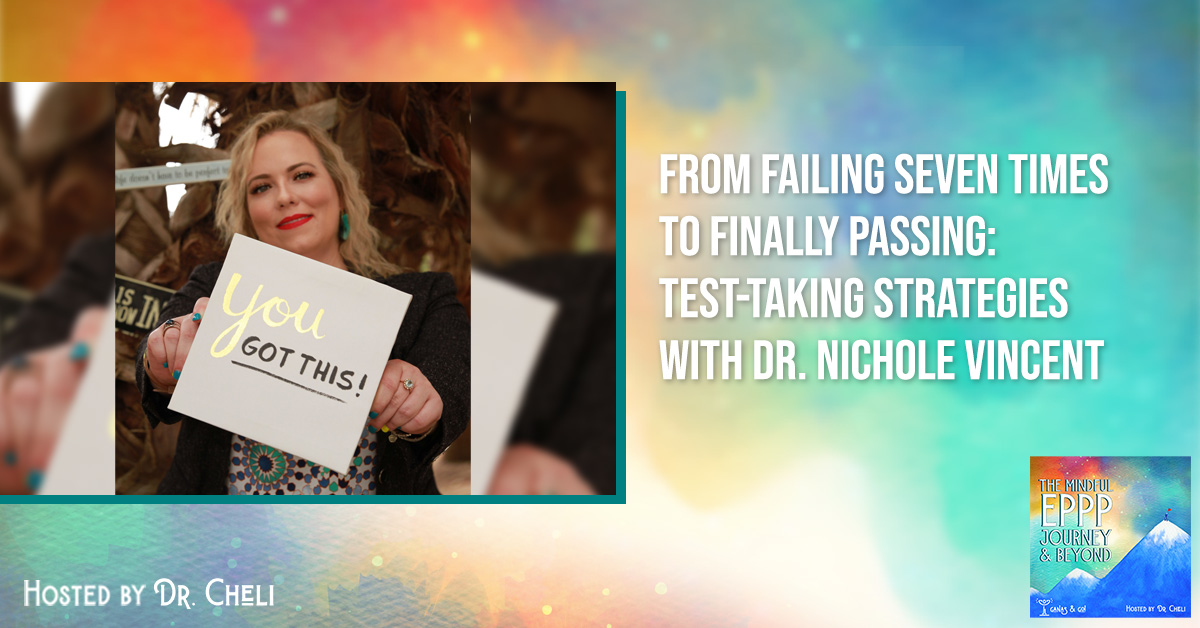
When taking the EPPP, test-takers really need to come up with their own test-taking strategies. If your friend chose one testing program, don't follow them. See what works for you. This is your EPPP journey after all. Other strategies include surrounding yourself with positive affirmations, taking a week's break before the test, and more. Learn all of these strategies from your host Cheli Lopez and her guest Dr. Nichole Vincent. Dr. Nichole is a Licensed Clinical Psychologist and is the founder of the group, From Pissed Off to Passing. There she helps multiple test-takers of the EPPP make a comeback so that they can vault over that 500 score. Discover Dr. Nichole's journey and how she failed seven times before passing the EPPP. Find out how she did it from wearing good luck charms to wearing t-shirts with positive designs. And, learn that even if you fail, you're only failing towards success.
Listen to the podcast here
Watch the episode here
From Failing Seven Times To Finally Passing: Test-Taking Strategies With Dr. Nichole Vincent
Thank you, Dr. Nichole, for joining us. Welcome to the show, where we explore the ganas behind becoming a licensed psychologist. We have Dr. Nichole Vincent, a licensed psychologist. Welcome.
Thank you.
This has been a journey in its development. The idea is that I want to share people's stories of success. The EPPP is a licensing exam for psychologists. It's one of the last things that we do at the end of our career after we have completed our Master's, our Doctoral program, practicums, internships, a Postdoc, and accrued licensure hours. We have filled out many different forums for our respective state boards and Doctoral programs. The end of this is passing this exam along with any other state requirements. My goal with this show is to share how people do it, especially for some of us that have struggled a little bit in passing the exam.
Ganas in Spanish is a combination. It's a very powerful word, especially for Latinos, Latinx, especially Mexicans. It's about having grit, resilience, and persistence. I couldn't be more excited to talk to Dr. Nichole because she exemplifies the ganas and grit that it takes to pass this exam. I'm excited to have you on.
First and foremost, I would like to thank some of the founding members of The Mindful EPPP Journey. This is something that developed out of my own frustration and lack of power in passing the exam. When I saw this image, I was like, "That's exactly what it feels like." We are climbing this last mountain, and I have had a lot of great supporters, including Dr. Patricia Zelaya, Dr. Angel Glover, Dr. Chantel Frazier, Dr. Melissa Munoz, Dr. Veronica Mercado, and Dr. May Bayani, who have supported this journey and let me pick their brains about this process and including Dr. Nichole Vincent. Welcome, Dr. Nichole Vincent. I met you through the various Facebook EPPP groups.
We met in one of the other EPPP groups, and you hopped into a group I created after I passed in May of 2019. In October, I launched my group. My group is exclusively for multiple test-takers, people like myself, Dr. Kelly, and so many other people. I define multiple test-takers as you attempted this thing once, it did not go the way we wanted, and then you are having to take it a second time or more.
My group is called From Pissed Off to Passing: A Group for EPPP Comebacks because that embodied my own process and journey. I find it has also embodied so many other people's processes and journeys. Initially, when I was coming up with the name for my group, I was like, "I wanted the word to rage in the group," which takes a lot to get me angry but I have had, and I still have so much anger towards this fucking exam.
Can you tell us a little bit about your background, education, and training and why you decided to become a psychologist? Is there anything in relation to diversity in terms of the addressing model and a little bit of your Doctoral experience before jumping into the actual EPPP? I like to get a little bit of background. When we get to the point of the EPPP, we are all starting at different stepping stones. If we were to do a research study on this, your Doctoral experience could probably be a predictor. Please take it away.
I will share a little bit in terms of my background. I grew up as an only child. I live in a tiny little town in Texas, a little border town but I grew up primarily in Georgia, in the South. I would consider my parents more middle class, and they divorced when I was nine. There's custody stuff. I’ve got into undergrad, and I chose to go out of state for undergrad, which also was a financial burden.

Test Taking Strategies: Pissed Off to Passing is a group for multiple test takers of the EPPP. A multiple test taker is someone who took a test and it did not go the way they wanted, so they take it again.
I still probably would have done it in retrospect but going out of state and paying out-of-state tuition when you have a certain grade aspect that, you can go pretty much have it covered in your own home state. I chose not to do that because I wanted to get out of where I lived. That started my awful stream on debt. I’ve got my Bachelor's degree in Criminal Justice. Initially, I wanted to be a criminal profiler, which was super inspired by X-Files.
There's also a great movie called The Bone Collector. I’ve got inspired and was like, "I want to do that. I want to catch bad guys." I’ve got my Bachelor's in Criminal Justice, which was like a cakewalk. I still worked hard for it but compared to everything since then, that was so easy. I took the GRE right out of undergrad and scored low. I also, by the way, took the GRE six times. I was hoping not to take the EPPP that many times. I ended up taking it eight times before I passed on my eighth try. That also is part of my own test anxiety. I didn't have high enough scores to start a Psychology degree outside of my Bachelor's. What I did is I took some gap years. I worked.
When I was 22, my father passed away. He was the first person I was close to that died. I took the GRE a few more times and didn't score high enough still from my own standards for graduate school cutoffs. I was like, "Let me get some more hours of Psychology." I enrolled in a Master's program in Louisiana, where I was living at the time, and got some hours. I finished all of my course credits from a Master's degree, with the exception of my thesis. At the end of my Master's program, I was like, "I'm still going to apply to Doctoral programs," and got in, which was great.
I was going to come back to finish my thesis. My Doctoral program was like, "Your hours don't matter to us because it was a terminal Master's program. You are going to have to retake all that anyway." I was like, "I'm not going to travel back twice to propose, defend, and all that stuff." At the end of my Master's program, what was significant for me was the program coordinator, and it was a small program. There were 8 or 9 of us students. I had a lot of trouble with exams. In my undergrad, I didn't have trouble taking a test. I would still get anxious but I would be able to complete it. I didn't notice brain fog or my mind going blank.
In the end, the professors and the faculty would stay late for me to finish. I would be the last person. I would take, on average, 30 minutes more because I would get myself so psyched up. I noticed that there was a difference. With undergrad tests, it was mostly multiple-choice, short answers, and filled in the blank. My Master's program was essay. I'm like, "I'm already wordy." I would try to exhaustively include all the details. I could max out the points, and that made me anxious. She's like, "You might want to get tested because I don't know if your Doctoral program is going to be nice the next day like we did."
I’ve got tested and had accommodations all through my graduate program, which was great and also not great because my exams were then up to five hours. I would max out my five-hour time limit, which was great training for the EPPP for stamina. I didn't think about that until now but that was helpful. It also turned up the volume of my anxiety. I would psych myself up. My hands would get sweaty. I would get sweaty. My heart rate would go up. I was in this anxious state the whole time I would be taking a test. I probably should have started medication. Every time, I would psych myself up, and then I would crash and feel relief until the next test.
I did that for five years in my graduate program. I didn't go to therapy for that. I didn't see a psychiatrist and get medication. With my Doctorate program, they had a Master's en route to Doctorate. On the day that I’ve got my Master's certificate, I was 29. It was delivered to my door. I had found that out later that day because I had shared that information with my mom. I texted her, and I found out my mom had passed away that day. I'm sharing that because there have been so many conversations I have had with people who are also studying for the EPPP. I was not studying at that juncture but there are people who have experienced so many losses, especially with COVID.
My experience of those losses at 22 and 29 and even since then prepared me for a grief experience related to when I would fail the EPPP. I didn't put those pieces together until I started to think about the things that were important for me to share. Failing is grief, at least for myself and for a number of people I have spoken to. It has been very visceral grief, not the same as the loss of a person but it's this loss of something that we have wanted, worked hard for, and we don't get it. I have never been punched or hit but it feels somebody has whaled on my stomach and my heart just dropped.
I love you because you give a shit. You take the time to ask people, check-in and say, "How are you doing? Where are you at?" You were telling me you are about to do that because you do that once a month. You have the unique perspective that you are hearing people's stories. I always want to know what's going on because it's helpful to connect to that grief and loss theme, especially during COVID, where we are losing people and jobs. It's this sense of loss that is different than any other I have ever experienced. Thank you for connecting that and sharing how you were prepared to deal with grief and loss in your life.
I finished my Doctorate degree. I graduated in 2016. My Doctorate degree did a great job of getting me ready for an internship and to be able to graduate because that's their job. They care about attrition rates and all of that jazz. I do not feel that my university prepared me at all for the EPPP. An example of that and what I have heard from a lot of people I have spoken with as well as I feel there should be a course that prepares you.

Test Taking Strategies: There should be a course that prepares you for the EPPP. Most courses only teach you the content. They don't really emphasize the things that you're really going to see in the test.
I know that they teach you the content like child development, research, and stats, and all other these things but they don't emphasize the things that, "You’ve got to make sure you have this stuff unlocked because you are going to see this come up on the EPPP." They did not have seminars to prepare you for the EPPP. We did not have an option to do an IO class.
Some universities require that as part of the curriculum. Mine didn't even have it as an elective that you could take, which is a big part of the EPPP. There were many places that my university did not prepare for. In some universities, students are able to secure discounts for grants, usually, one, not across the board for all five testing programs but my university didn't have that either. It was like, "Let's get you to graduate. You’ve got internship. Bye," and that was pretty much it.
You did a PsyD program, I did a PhD program, and I can echo what you said. That's also across the board. There are a lot of programs that are not preparing us enough to get to this point. Some formal Postdoc programs like APA, APPIC-accredited embed that into their program, which is awesome but if you don't do a formal Postdoc as I did, then you are left to figure it out on your own. That's a good point if somebody is in a program to ask that in your program or recommend that if you have already finished.
Experiences with loss and grief early on will prepare you for future failures.
Thank you for that. I'm curious, and I know a lot of readers are interested in the EPPP journey. We are going to talk about this in a few ways. First of all, it's the logistics. The questions that people have, whether they are starting the journey or in it, haven't passed and thinking, "I need to re-strategize." You have told us you are a multiple test taker. You passed it on your eighth time. What was the time span that you have spent? What are the materials? You are awesome in the sense that despite your experience, you are pretty versed in all the different companies. What was your process? What did your study process look like? How did that pivot after each time that you did not pass?
I will briefly talk about the different things I did with the different companies. I also have a 6 or 7-page long list of all the things that I did that I typed up after I passed. In terms of the timeframe, it took me two and a half years to pass. I started little EPPP me very blindly. I did not shop around and try out different programs to see which one worked for me.
There were four test companies at that time. PrepJet did not exist. I wish that they had. If they had, I would have started with them or PsychPrep first. I did do PsychPrep but later. I started with Taylor Study Method because I already had a hard time with exams. I took the GRE six times and my grad school process, and my Master's program. That test anxiety had started, continued for two years and got worse in my Doctorate program but I had that extra time.
For me, I picked the Taylor Study Method because, on their website, it says, "We have a 94% pass rate." I'm like, "I only want to do this once." I don't even want to do it once, but you're telling me I have to. I already thought I did all the hard stuff like getting my Doctorate, which I worked my ass off for five years. I'm like, "I don't want to take any chances." I didn't see anybody else say 94%. The other companies did pass their pass rate. I picked them based on their number, which ended up being a very big mistake. I didn't try them out. I signed up with them for a six-month package.
I will also like to interject and note that everybody's experience is very different. Different companies work differently for people. It's not to say that any one test company is better or worse, although we are biased because we have our preferences. This is not to talk bad about any testing program. This is your personal experience. Some people pass for the first time. This is making that point that it's not like, "If you do this, if you follow A, B, and C, then you get this output." It was not a good fit for you at that time.
It was not. On my first two attempts, I used the Taylor Study Method. When I wanted to study, I had a clique. Many people had a core group of people in your Doctorate program that you leaned on and studied with who are your peeps. When I was getting ready to study, preparing for the end of the internship year, I started to message people. We were all doing different things, trying to transition some of us from Postdoc to staff positions right out of the internship. I chose to do a Postdoc. Four people were like, "Nichole, we are not there yet."
I'm like, "Come on." I'm a great self-starter about something. If it's anything creative, decorative, colorful and adventurous, I will plan that trip. I will make the itinerary. Let me look up flights. I will do the things. If it's things that I'm not looking forward to, such as studying or working out, I am someone who does best when I have accountability. When I have other people doing the things with me that I don't want to be doing, it helps me do the things.
This was one of those things where I'm like, "I had my ducks in a row." I picked my program. I'm like, "Let's go." I was ready, and nobody wanted to study when I was ready to start. That was hard for me. Over the course of my own time with the EPPP, I did several different boot camps and study groups. To be honest, the first couple I did, I was a lurker and a leech in a group. I would be there for the resources. I wouldn't contribute. I didn't post questions. I didn't share stuff about my own experience, a-ha moments or, "I found this cool video." I was not that person.
Being someone who runs a group, I'm like, "That's so annoying." I was so annoying as a group member. I was sucking on the resources. None of my people wanted to study, so I did the Taylor Study Method. I failed. My first two times, I don't remember my scores. The first time, I spent three months studying straight. I don't remember how many hours a week or how I did it but I would even go into work on the weekends to set up a testing condition environment with my phones off and sitting in a place that's more like how I might sit at the testing center and things like that.
I did those things, and I took the test. I did not get even close to a passing score on a practice exam but I worked so hard and I was dedicated. For months, I was like, “Hope and a prayer. It's going to be okay.” It was not okay. I’ve got a three-something. I remember it was in the 300 range the first time I tested. I went back to the drawing board with the Taylor Study Method and went through their program and process. I still didn't get high scores, and I was like, "I'm going to try again."
In between the 1st and 2nd attempts, this was at my Postdoc. We did have hours. They give us maybe 2 or 3 hours during our Postdoc that we could have dedicated study time, which was nice. In terms of having materials or anything, that was not something that my Postdoc provided either. I was doing and figuring out everything on my own. I also tried to rope my Postdoc partner. There was one other Postdoc there to like, "Study with me."
For the first time, half of our Postdoc was like, "I'm good. I'm not ready yet." I was still struggling because none of my people were ready. He later went on to not even sign up for a program. He paid for the EPPP Pocket Prep app, which we practiced together. He took half, not even a whole practice test of an old practice test, and passed on his first try.
I was like, "Are you fucking kidding me?" We also tested on the same day when he tested, which was an awful and terrible idea. I do not recommend doing that for anybody. We tested in the same testing center on the same day. He had started an hour before me. His 1st time was my 2nd time. We had plans after to go see a movie, and I still went. I did not want to go but I wanted to also be supportive of him.
That's a good point because we see that in the groups a lot. We are grateful and like, "Congratulations. You did it." I have heard this a lot, and even myself, it stings a little but it doesn't take away how happy you are that somebody passed. It's like, "Good. You made it. Awesome," but it's also like, "I wish I would have passed, too." I acknowledge you for noting that because that's an internal struggle that we don't want to take away from somebody else but also validating our experience is important as well. I try my best to do that. As soon as I see somebody who passes, I'm like, "Congratulations. That's amazing. That's excellent." It’s because I know how hard it is for some people.
That certainly was my experience, too, especially in groups. Before I started, I joined all the Facebook groups I could find at the time. Now there's more, which is great. Any time I logged on and would see people post that they failed, I would start sweating. I would notice my heart rate go up on my Fitbit. I'm not even doing anything, just reading. Seeing that, I would get a sense of dread. I felt that almost every time I would look in the group, somebody was posting that they failed for whatever a number of times.
I'm also seeing people post, "I passed on my first try." Before I took it the first time, I was hopeful. It gave me motivation. I was like, "That's going to be me." It wasn't me, and I had so much grit, that dialectic of we want to be hyped up and excited for somebody for passing because we know how hard it is. Also, at the same time being like, "That wasn't my experience. How did they and not me?" We then get into that comparison trap, which is not good for anybody.
That was a lesson. A growth area for me is that we have to apply everything that we learn that we teach our clients and patients. The DBT stuff, the CBT, the mindfulness, the behavioral activation, and the ACT. All these different interventions that we teach our patients, we have to apply them to ourselves, especially that CBT part where we can go 1 or 2 tracks.
We can spiral down with the cognitive distortions and get into social comparison, especially with social media which can negatively impact our mental health. For me, it was choosing to scroll through, "What are those stories of triumph?" Part of the inspiration for this show is listening to NPRs podcast on how I built this and also diving into Brené Brown's work full-on. I even have her book in my bookcase.
Rising Strong was so pivotal for my upward swing, looking mindfully and also mindfulness, hence, the Mindful EPPP Journey is being mindful of what are those stories that I consume. There was a point where I was looking at all the stories of triumph. It didn't matter the 1st, 2nd or nth time. What did they do? What can I grasp on to? At some point, you are grasping. You are like, "I need some motivation to keep going." Going back a little bit to cost and any other study materials that you did, used, and then we will talk about how you did it.
In between my 1st and 2nd time, I had interviewed for a job for a staff psychologist position. What was great about that is I had to be licensed within the first two years. I was gunning hard to be licensed before I started that position on the Postdoc, however, it did not happen. I felt awful because, in my interview, they asked where am I at with the licensure process. I explained, "I'm about to take it or I took it once. I'm about to take it again." I did get the job, and the nice thing also is they paid me as if I was already licensed.
However, in comparison to the salary I'm making now as a licensed psychologist working in a different industry, it was nothing. I look at it also as, "Postdoc paid me. I didn't make enough to live on in Postdoc." It's significantly a lot more for that position for three years where I did get licensed. I'm like, "How can I keep going up?" After I failed the two times with the Taylor Study Method, I switched gears. After I failed the second time, some of my friends were studying or open to studying more.
In particular, I have one of my besties. She and I both get anxiety around exams. We studied for almost every single exam together in grad school. I was so stoked when she was finally ready to start going. I'm like, "This is what I need. This is what I have been wanting." I was so happy because we started our own little two-person study group. We are super hardcore. When I go hardcore, I'm all in. It's easier when somebody who is on your level of being all in is helpful.
Get your friends and peeps to do the things you hate with you so that you're not alone.
I attribute that to the transtheoretical model or the stages of change. Where are people at? Are they in precontemplation, contemplation or action? You want to be with the people that are in action, like," Let's go. Let's do it."
She was using PsychPrep. At that time, I had some great friends who shared some materials with me between AATBS, Academic Review, and things like that. I was using a bunch ofdifferent materials. I found AATBs for myself. I liked their exams but I didn't like their volumes of material in the same thing with Academic Review. It was too overwhelming for myself, which is what I ran into the Taylor Study Method. I already knew, at least from my experience with them and failing using them. It was too much. I was too saturated with content.
I used a mix of AATBS, Academic Review. I found parts of it I liked, and I didn't. I also did the PsychPrep weekend workshop. I started listening to Dr. Jablon. In between all this, I'm squishing everything together because I don't remember the exact timeline but I failed more times. Around my fifth time, I’ve got a 495.
After I failed, my fourth time was when PrepJet was a new kid on the block. I had already experienced the workshops of the other programs that existed and the materials. I figured out what worked and what didn't work for me. I signed up with PrepJet, and I failed a few times with them. I attribute my failure, not the 1st one but at least the 2nd and the 3rd, is I overexposed myself to the content and the tests.

Test Taking Strategies: Try not to overexpose yourself to the content and to the test. There comes a point where you've taken the test so many times that you fall into a false sense of confidence.
This is where a lot of people fall into is you get a false sense of confidence. For me, I took each test. There were five tests available at that time. Now there are six. I took all of their exams six times spaced out but it was still within a twelve-month period or so. I took all of their exams six times. That's 30. I took all of their subdomain quizzes twice. I read their content many times. I also bought their lectures when those came out towards the end of my experience and was scoring in the 80s on my practice exams. I was so stoked because I had not ever gotten that high before but I didn't realize that it was practice effects.
I had this false sense of confidence. I took the test and failed. I s
witched up again. I still love PrepJet and PsychPrep. From my experience, they did the best job or did the best job of sectioning and organizing content. It is not like drinking from a fire hose because that was what my experience was before that. I didn't know anything but to drink from the fire hose of EPPP content. I'm like, "This is not working," and it made me feel overwhelmed all the time.
You lose steam, and that feeds into the lack of motivation. Those are my top 2 as well and the 2 that I'm using.
To answer in terms of cost, I meant to dig up my old tax return. The first year, I was able to claim a bunch of that on my taxes. The second year, they changed something with the tax code, so for professional development, I was not able to claim EPPP expenses. I'm guesstimating that I was at about $13,000 of debt at the time that I finished. Most of that I charged to credit cards.
There were times, for Christmas or for my birthday, I asked family members. I'm like, "I don't need anything other than money for this test. Can you please help me pay for this exam?" It's almost $700 a pop, and I took it 8 times, plus I rescheduled it outside of the 30-day window. That's almost $90. I did that 5 or 6 times in total for my journey, not including my licensure expenses, and my application also expired.
I had to repay my board more money for information they already had on me and get new fingerprints because apparently, I'm like, "My fingerprints are the same as they were like but sure. I will pay another $70 to get them done because you are making me." There were a lot of things that I experienced but roughly, I would say $13,000 is my estimate in terms of my cost. The other thing, study materials-wise, that I found the most helpful was Dr. Jablon. To me, she was the best audio.
I had a two-hour commute each way to work. That's four hours round trip where I would be driving every day for my last job. I would listen to her on my way there and on my way back. That was helpful in terms of using my commute in that way. I also did the Academic Review six-week workshop with some friends, and that was helpful. I also did the Academic Review/AATBs four-day live workshop. That was like a massive brain dump of all things EPPP. It's like you are in class nine hours a day, and it's a lot.
That's how I started. Before I did anything at the job where I was at, somebody sent an email about some coupon of some sort. I was underemployed at that time. I don't even know how I was able to afford it but I paid the $500, $600 for four days. I was like, "I don't know where to start but this workshop sounds like a good intro." I left like, "This is a lot of information," but it was good to go and know. Looking back at some of the people I remember that were there, I'm like, "I totally get some of their reactions to some questions." That was how I jumped into the EPPP pool with the four-day workshop.
I thought I was at the deep end. I think that's more of a deep-end jump. I can't imagine because, at least when I was consuming content from the EPPP fire hose, I was pacing. Whereas that workshop it’s pasted and structured for you. You are sitting there. I can't even imagine condensing that. It was helpful for me when I found I had already mastered the content. It was a review. Some people use that workshop as a review right before the test. When I did the workshop, there were probably a handful of people, maybe 30 that were there, who were testing that Monday. The workshop was dropped up on a Sunday, and they were testing on Monday. I'm like, "How do you do that?"
Now, I get it. I'm like, "That makes sense." I wanted to dig in a little bit in terms of using the CBT model, our thoughts, feelings, behaviors, physical effects, and the Lotus flower representing mindfulness. I found that it’s very helpful to be mindful, be aware, be present-focused as to the experience. Could you share a little bit with us about what that experience was? If there has been any adverse impact on your life, career and how did you get through it? How did you get out of that? What was your experience? What did you do?
The adverse impact for me had more to do with financial consequences. My Postdoc paid me very little but there were other reasons I picked my Postdoc. It’s not for the money. It was to be close to my partner. It was worth fit for me, even though I did go into a lot of debt because I wasn't able to live off of my salary. A lot of people I speak to and have spoken with have lost their jobs because they have not been able to get licensed and I was coming up close to that. I passed in May but my two-year mark for that job was August 1st.

Test Taking Strategies: The adverse impact of failing the EPPP so many times is the financial consequence. A lot of people have lost their jobs because they have not been able to get a license.
I had failed so many times. I'm like, "I don't know if this is what I'm going to do." I never brought that up with my boss, mostly because I was so anxious about it. I already felt so much pressure. I didn't think I could take the pressure of like, "If you are not licensed by August 1st, you can't work here anymore." That would have probably been the nail in the coffin at that point. I don't know what I would have done and how that would have impacted my studying or performance with study or work.
The financial aspect and having supportive people are the biggest in terms of the things that got me through. My best friend passed. She kept studying with me because that's how hardcore she was. We would review content in the car. We would go over the mnemonics that we came up with in the car on my commutes home because I had the longest commute. She kept saying, "We are doing this." That's her mindset. I knew once I could get her onboard to studying, it would be so helpful.
My boss was very supportive in terms of allowing me to have time. I couldn't study at work but she would let me take off time from work. That still had to come out of my vacation time or my sick time but at least granting me the approval to take these off before my test to better prepare or take off time for that workshop, for example. I was being creative in terms of thinking outside the box. Every time I failed, which is why I have a 6 or 7-page document of things I did, including extreme things like hypnotherapy for test anxiety, acupuncture, medication, and meditation.
I made collages of positive affirmations. I put Post-it notes all over my house like, "You can do this. You can miss this many questions and still pass," on my bathroom mirror. Every time, I pulled out all the stops that I possibly could. I color coordinated things. I did all the workshops and audios. Anything I could find, I did it. I joined any study group I could join, even when I was a creeper lurcher person to suck all the resources. I did that. I started to contribute more. I’ve also got positive shirts for myself. Every time I tested, I wore a different shirt.
I made my own T-shirt. I made a couple of T-shirts for myself. Now, I also have them up in a store. We are our own cheerleaders.
It’s because you are not allowed to wear jewelry, I put good luck stuff in my bra. It was a bracelet my mom had given me. It's like a mustard seed of faith. Some of my shirts said, "I cannot quit because I'm currently too legit." Another one said, "I can, and I will watch me." Towards the end, I let one of my friends pick my shirt, and I framed it with my license.
It's in my work office, not my home. I was like, "Maybe somebody else needs to pick the thing I'm supposed to wear," so she picked the shirt. I was like, "I'm buying it." The shirt said, "Nevertheless, she persisted." Underneath that, it said, "The future is female." I bought it. That's what I wore the day I passed. I cut and framed it with my license.
When somebody who's on your level is being all-in on something, it's really helpful.
You have to post a picture of that.
I did. This might sound silly but I'm talking about thinking outside of the box and anything that I could think of. "What is something I didn't do? Is there something I didn't look at, didn't read, didn't listen to or didn't watch?" I forgot where this idea came from but I’ve got a marker on the bottom of my feet. I wrote "passed" on one foot and then "EPPP" on the other foot.
That was a grounding thing for me that helped keep both my feet on the ground when I was testing and helped me at the moment in figuring out whatever I could do. Those are some of the more different things that I did. Coming up, I spent so much time trying to find visual aids. Once I did all five programs, a deficit I find in all of them is for visual learners like myself. We like colorful visuals.
Her background is a beautiful bookcase. I love color. I study the Psychology of Joy because of this experience. It's beautifully color-coded, bright and very lovely. I'm also a visual person as well. That's why we connected so well.
Fact for our readers, Cheli also makes jewelry. I do, too. Some of it I have been doing for many years. That's my own art therapy. For me creating my own, I tried so hard to find visuals on Pinterest or Google. I wasted so much time. I bought other tools thinking, "This is going to be the thing that I'm looking for." I couldn't find anything that fit what I was looking for.
Towards the end of my journey, probably after I failed the sixth time, I started to make my own visuals and my own pneumonic. It was time-consuming. I didn't go and finish that until after I passed because I wanted to share that with other people who were learners like myself. I can't be the only person that's like, "All this sucks. There's nothing out there."
I am a visual learner myself. Part of what makes our connection so strong is that we are both jewelry makers. As we kept talking, we were like, "You do this? Me, too."
I love dogs.
We are both fur mamas. The visual piece for me after the 2nd going into the 3rd was I had to pivot. I had to take a step back and look at, "Cheli, what are you doing? What are you not doing? You need to re-strategize." If I read, I'm like, "That doesn't make sense." Show me a visual, and it clicks.
I started creating my own. We were both launching around similar times. My coping mechanism is to create visual study guides because, in this process, I also discovered. For people reading, take a moment. Part of the difficulty with this is that being a psychologist is our identity because it has been for so long. We have been indoctrinated in this field. We have been enculturated into this academic lifestyle, and any deviation from that is less than or at least for me, it felt less than.
I get a lot of people who are like, "You are wasting time creating those visuals. Just take the test." That doesn't work for me. I have to have a visual, and if I create it, I'm encoding the information in a different way. To me, it's fun. I discovered I love graphic design. It's interesting because in undergrad and grad, whenever there was any group project, I was like, "I will do the PowerPoint. I will work on that."
That was me, too, honestly. "I will make it pretty."
"I will make it clear and visually represent what we are trying to say." What we are tapping into is, for those reading, what are you good at? What is that thing you probably downplayed a little bit but is your strength? I purchased your visual study guides. I haven't gone through all of them yet, and I'm sure there's some overlap there. It's amazing that you created your own study guides. That's the overlap between a Doctorate and entrepreneurship. In academia, we find a problem. There's a gap in the literature. We were like, "This is an issue. I'm going to research it. I'm going to fill that gap." That's what makes us unique as Doctorate-level clinicians.
For entrepreneurs, they are parallel in that way. They say, "There's a problem here. Enough people have this consistent problem. I have an idea that can fix that. I can fill that gap," and that's what makes us unique as Doctorate-level entrepreneurs. I love that you are talking about your visual study guides because they are amazing. Keep going.
I love that you brought that parallel up in terms of the research curiosity aspect of being a psychologist and also an entrepreneur because we also share that connection as well of having multiple entrepreneur avenues that we are doing simultaneously along with our practices.
We are also doing the Dave Ramsey plan to the Financial Peace University to get out of debt.
It is a big motivator for me. I'm calling financial freedom my love language. Freedom was my word, and that mostly had a lot to do with financial. Creating my own helped me, and I didn't know at the time that anybody would find value in it but towards the end of my own study journey before I passed. I was sharing it with my study buddies at the time. I had a great study buddy experience with somebody.
Tina G had reached out to me, which was super random. She saw me show up a bunch of times in the other groups even though I was a creeper lurcher sucking up the resources, I would still show up on the calls. She would see my name. I didn't know who she was when she's like, "We have been in some of the same groups. I'm trying to get a study group together." I was like, "Sure."
It was me, her and two other people. We were all hardcore, and that helped as well. We met several times a week for a couple of hours. When I shared my stuff with them, they were like, "This is so helpful. I understand this now." I was like, "Really?" It motivated me to keep creating and doing it. I wish I would have started that at the beginning because I could have saved myself so much heartache, money, time, and attempts if I had done what I thought I should have done in the beginning but I didn't figure it out until the end.
Ednalice Pagan Romney had talked about the expectation. When you are talking about the grief and loss, it's like when you go to take the exam a couple of times, and you go in like, "This is my time," and then it doesn't happen. Dr. Veronica Mercado noted after the four-day live workshop how we feel physically ill, and she's giving you kudos for your study materials, which are great. Some of the things that she's done are writing, "Seventy-five and above." In New York, you have to have a 75 and above. It's the equivalent of a 500 for the rest of us.
Dr. Gounalakis asks, "How did you study when you finally did pass?" This connects with our next slide about your words of wisdom. You have done all of this throughout your journey. To those people that I interact with, I delved into sports, positive psychology, and mindset. Mindset has been so key for me in improving my scores. I thought like, "What's a sport that seems ridiculous?" You are like, "How the fuck do you do that?" I was scrolling through YouTube, and I found pole-vaulting. You look at pole vaulting and ire like, "It's so high." It's 15, maybe higher feet that you have to use a pole to run and then jump over this.
I was also looking at Olympians because we are the Olympians of academia. We work so hard for that Doctoral defense, that's an hour or two hours, versus Olympians that work so hard all their lives for that one minute to win that race for the gold medal. I think of us at that caliber and level. In the EPPP, I see the 500 as the thing that we have to jump over. It's that pole-vault but with an 800 mindset.
Every time you fail, do something creative and out of the box. Pull out all the stops.
Instead of, "I can miss this question or I don't have to know this." It's like, "What's an 800 mindset? How can we jump over? How can I get the most points?" Given everything that you have done, even creating your own study guides, what do you think helped you with that last step? Was it a mindset? Was it that you kept taking more tests, you created your visuals or you had community? What would you say is that thing that helped you pole-vault over that 500 score?
I get this question a lot from a lot of different people. I have developed a disclaimer before I give this answer, which is there is no secret sauce to passing the EPPP. Everybody would like a secret sauce. There is not one. The other thing that I do want to point out too is asking somebody what they did to pass. If Cheli was doing keto and getting amazing results and I'm like, "I'm going to do keto too," and then expecting myself to get the same results with Cheli.
Different things work for different people. For myself, the thing that contributed is a consistent meditation practice. The thing that I have found helpful is I would do meditation at nighttime every night. I worked on my sleep as well. Positive affirmations were part of my journey from the beginning but that's also who I am as a person and as a professional.

Test Taking Strategies: To pass the EPPP, you can do meditation at nighttime. It will help you sleep better. Have positive affirmations all around you. Then go to workshops and think of them as brain-dump reviews.
I have stuff plastered all over the place, like little reminders, quotes, and things like that. That's me. After I did that four-day workshop, which I also found to be helpful mostly because it was a great brain dump of a review. If you go in, thinking about it that way, it doesn't feel as overwhelming. It still takes a toll on your body but it's not like, "I don't know anything."
I’ve got to a place where I figured out I mastered content pretty well. I worked on my test-taking strategies, which helped get me over that score that I needed. Taking this test, from my perspective, is very different than taking the GRE, any test I took in my Master's program, any test I took in my Doctoral program or any test I took in my undergrad.
Yes, it's a multiple choice test, and if you say that, it sounds easy but it's really not. The things that worked for me in terms of test-taking no longer worked for me. It took me a long time to figure out how to analyze the question, "What am I looking for?" I was slowing myself down because, as someone who does have anxiety with exams, I would speed through the question. "I’ve got to hurry up. The clock is ticking. I’ve got to go," instead of pacing myself. The day I took the test, I didn't start with question one. I started randomly at question six.
Did you skip right to question six?
I did because that was a strategy from the four-day workshop I did. On the last day, they talked about like, "What does your 30 days before your test look like?" They broke it down and gave some structure and ideas. I was like, "I haven't tried," coming back to, "What haven't I done?" I created things to do. I did things other people did and didn't get what I wanted. What else can I do? I never had this idea of, "I did everything. I'm just screwed." I never had that mindset.
I do think that that helped as well because I always came back to this place of, "There has to be something else I can think of. There has to be some other strategy," and I will make it up. That's what I did. I started with a different question, and I did that mostly because that took the edge off. If I’ve got question one and I'm like, "I have never heard of these words in my whole life. I don't know what circumscription or whatever is, and I have never read this thing," I would freak out.
That can happen at question six, too, but it's like, "This is question six. It's not the first question." I would go back for those. For me, that was a weird ninja mind game thing. I also used the mouse tutorial, which is five minutes. This was another strategy from the workshop that I found helpful. I would use that five minutes where it's click here, and it's like teaching you how to use a mouse.
We are like, "If we don't know how to use a mouse, we should not have Doctorate degrees." Instead of clicking and click to rush through that, with my anxiety being, "We’ve got to hurry. We’ve got to go. We are ready. We are going to forget all the things if we don't do it now," I took that time, closed my eyes, and breathed. I was mindful about the time because if it times out, the test is done.
I was mindful. It's not like I was falling asleep or anything. That, along with the positive affirmation, I wrote down my test date. I started to do this two months prior to testing. I always had different affirmations each time I would write on my cheat sheet, the little laminate piece of paper they give you that you can write things down on.
Every time I took a practice test, I would write my test date in the past tense. I wrote May 2019 was the day I passed even though it was March. I was writing that every time. I would write also underneath that, "I know and will remember more than I think that I do." Those were some things that were different from what I did going in. It's also having time. I don't recommend you work a full week and then take the test. Even if that means you have to call in sick and you are not really. You can be sick of the EPPP. I'm going to call that legit.
In Spanish, we call it harta. You are so sick and tired of it. You don't want anything to do with it anymore.
If it's that or whatever, use the time, and I would encourage taking at least five days off before you take a test so you can maybe squeeze in another practice exam early in that week. The rest of it should not be taking a test. If you want to practice your content, do that with quiz questions. Do not take a test within 3 to 5 days of you testing. If you get a score back and that score is not an amazing score, whatever you view that as, then that can mess with your confidence going in.
I haven't made a graphic for this yet, but that's on my project list of things to do. EPPP, from my perspective and also my combined conversations with hundreds of other people since I passed is it boils down to four things. It’s mastering content, testing strategies, managing the fuck out of any test anxiety that you have that totally fuck you over no matter how great of a test taker you are and no matter how wonderful you know that content backward and forwards. Also, consistency in your studying and practicing with the content.

Test Taking Strategies: Passing the EPPP takes four things: mastering the content, test-taking strategies, managing any test anxiety that you have, and consistent studying of that content.
That doesn't mean you have to do it every single day but it needs to be pretty close to that. Even if it's touching something for five minutes, even if it's reading a quick little summary when you are sitting on the toilet, I don't care. There needs to be consistency and practicing like that free recall or connecting it to your every day.
Dr. Mercado says, "I wrote all the names of the people in my study group on my whiteboard to ease my anxiety as I took it. That's helpful as well." Can you repeat those four things?
It's like a four-layer cake in my head. I'm going to make a graphic for this. I'm a foodie, and Vero knows that. We have had multiple conversations, and there's food all in my visuals, too. I picture a four-layer wedding cake, except instead of the top where it's a bride and groom, it's like, "You are EPPP happily ever after," is at the top.
It's a single sheet of paper.
The four things are managing the fuck out of your test anxiety and mastering content. When I say mastering content, that doesn't mean you have to score 100% or a 90% on your practice exam breakdown for that area. It does mean when you get the pretty upper 70s or close to 80s, I would say that's demonstrating some level of mastery of content where it doesn't matter how a question, an item or concept is presented to you. You can pretty much, "I can identify that it means this kind of seizure. They are asking about this imaging. They are talking about this type of drug." You are able to at least hone in somewhat on, "Where is this coming from or what is it?"
The other thing I also talk about is what means what. There are a lot of synonyms. One thing means another thing which means another thing. For example, if we talk about homeostasis, it has a lot of different names to that depending on what domain area you are in.
There is no secret sauce to passing the EPPP. Different things work for different people.
The other two are test-taking skills and consistent studying and practice.
Are there any other words of wisdom for either first-timers or multiple test takers?
For first-timers, shop around all of the five testing programs. That's the Taylor Study Method, AATBS, Academic Review, PsychPrep, and PrepJet. All of them have a free trial of some sort to give you a little preview of what their program is like. Don't pick AATBS because of your best friend, somebody in your class or somebody else you work with.

Test Taking Strategies: For EPPP first-timers, shop around the different testing programs. All of the five testing programs have a free trial that gives you a little preview. Don't just choose one because your friends chose it.
Don't pick that because they've got good marketing.
Also, first-time test takers, be prepared. You can take their trial practice exam for free. All of them are marketing to scare you to get a low score like 99% of people do, which I have encountered anyway. I can't say, everybody.
There is 0% readiness or something like that.
That you are so low on the totem pole. You do need their help, and they can be the ones to help you, which is a marketing strategy for them to get you to be like, "You are right. I don't know anything. I’ve got a 27 on this test, and I need a 70." They are all geared to freak you out. They are all hard on the trial practice exams to get you to buy.
Make sure that you are aware of that and also not let that wreck your level of confidence as a clinician. This test has nothing to do with how well we can take a test. Our clients could give two fucks about how well we can take a test or if we were ever on academic probation in our programs, which I was or had to repeat a class, which I did, how well we know steps.
Our clients don't care about that. Our clients care about my pain points. They don't know that language but they are like, "I hate my boyfriend. I'm so depressed, and I can't get out of bed. I'm so anxious every time I go to do a job interview." They come in with a problem. They want to go to a regular medical doctor and say, "My big toe hurts. Can you fix my big toe?"
It's about the working alliance and, "Can you help me?"
This test has nothing to do with, "Can we help people?" This test is a hurdle. I hate to call it that because that signifies certain things that we are supposed to get through. It's part of the process for us to get licensed, which is important for whatever reasons but keeping those things in mind. The other thing that is important is that I get asked a lot, especially when you have taken the test more than one time like we have, you accumulate. Sometimes even first-time test takers, if you have hand-me-down access to materials or things that we can get inundated with, "We have flashcards from this company. We have the books from this company. We have all these things."
If you spread it out in your study space, it can be overwhelming and not everything, I promise. I would be willing to bet money, which is something Cheli would know I do not do because I very much value my money. I would be willing to bet money, whoever is reading, that you have stuff, whether it's stuff you purchased or stuff that's hand-me-down that is not working or serving you. You feel guilty for not using it or you are not getting your money's worth. I want to give permission to whoever needs permission to pick the things that work for you and leave the other things out.
We both have this for 2021 but I have a little thing that says, "Less is more."
I made a little flyer. My word for 2022 is less. I haven't put it over yet.
That's a good point because when I started my journey, I was unemployed, and then I was underemployed because I had a lot of grant jobs and gigs. I couldn't afford the study materials. I had to get, so a lot of people were super generous and kind. I had a lot of hand-me-downs. Some of them were a bit older. I inherited a box from somebody who's super awesome.
I was like, "This is so overwhelming. I don't know what to do." I wouldn't do anything because I would freeze. To your point, is to pick one track. For example, I'm using PrepJet study material, and I'm listening to the audio for PsychPrep. That's a perfect combination of my personality and my style. I love Dr. Jablon's humor.
Pick a lane, stick on that lane and then switch lanes whenever you have to. We are on a highway. Personally, when I'm taking a long drive, I pick the fourth lane and stay in that fourth lane as far as I can. I pivot and switch when I need to but I always go back to that lane. Pick a lane, test that out and see how that goes. Is there anything else on your list?
I'm sure that there's more that I have written down but those are some of the main things. What I encourage people is to pick a lane. I'm going with that highway metaphor. You can detour and consult. Let's say you have AATBS, and that works for you. That's awesome. The main thing at the end of the day, it doesn't matter what you use. It's, "Does it work for you?"
If AATBS works for you and you are in the AATBS lane but you are like, "I'm not clear about the difference between James Lange and Cannon-Bard. I have no idea." I'm making something up. "I'm not getting it from how they explained it in their volumes or on their flashcards. I'm not understanding their workshop or audio. Detour, if you already also have PsychPrep stuff. I'm going to detour real quick to look up this little thing in PsychPrep because PsychPrep helped a little but ATTBS is better." I don't feel that way but that's just me.
PrepJet does a nice job. I'm as soon as you said that, I was like, "I know that one."
Detour a bit to pull that material out. Consult with it and then go back. You are still in your AATBs lane, and you are not overwhelmed with, "I have all these things, and I don't know what to do."
Dr. Nichole, what's next for you? I had a lot of input from some colleagues in my study group that talked about the beyond piece. The beyond is the important part. It's not just EPPP, you pass, and then you are done. It's like, "We get to start our careers. We get to continue our careers. We get to do the things we always wanted to do." You talk about a bucket list. I saw one of your posts. What's next for you? Where can people find you? What are you up to? Dr. Veronica Mercado asks, "Are there any parts to the study guide or updates? Where are you at? Tell us more.
Do not take a test within three to five days. Take at least five days off before the test.
I'm still going to stick with my full-time job, which is working for the Department of Defense at least for another seven months. I also have a part-time private telehealth practice that I had planned to do even before COVID was a thing. I have that as well on the side where I see clients and do therapy because therapy is my jam. I don't get to do therapy for my big girl job working for the Department of Defense. I'm planning to continue to wholeheartedly as much as I can carve out time and support multiple test-takers to pass.
I also create a lot of free content as well, handouts, mostly. During the internship, I have the nickname of being the "handout fairy" because I always had handouts or I would make handouts and leave them on people's desks and chairs to use with their clients that I would hear about in case they wanted to use them. I love making handouts. It's one of my favorite things.
I make handouts, not so much for content. I make it more for support. These are things for time management. I had an idea for something else I'm going to make as a supportive thing to help structure study schedules, content, learning material, and emotional support in terms of how do you continue to get motivation and things like that. I'm going to keep doing that for as long as my heart is excited about it.
I'm also going to be supporting people so that they hopefully don't struggle as much as I have with my own process. I had a lot of support. I know not everybody does. I had a lot of things still in my favor, and it still was awful and terrible even with a supportive husband and a job that was stable. It can be very isolating. My job is to help it feel less like that, help people feel less ashamed of failing this exam and realizing you failed your way to success, which is something that I heard. I was like, "That's me. I failed my way to success with the EPPP." That's exactly what I did. I kept failing until I didn't have to anymore.
The word failure is very negatively charged sometimes or at least it appears that way, and it is to some extent. However, in the entrepreneurial world, it's not a bad word. It's a growth word. In the entrepreneurial world, when you are launching a business, they say, "Fail fast. How fast can you fail?" As soon as you fail, you pivot. "You only fail when you stop trying," is what they say, which is why I love entrepreneurship. It's this go-getter mindset and pivot, what works, what didn't work, innovate, and pivot.
That's what we are doing in the time of COVID. Our field had to pivot to Telehealth and Telepsychology even though there was much resistance but we had to pivot. Failure to me is based on Brené Brown's book, Daring Greatly. I created a graphic for this. We’ve got on the court. The Theodore Roosevelt quote is, "You get into the arena, you are marred, you’ve got beat up, and you get up." You’ve got beat up but you dust yourself off. You take care of whatever you need to take care of, give yourself time to grieve, take care of yourself and then get up.
It's not easy but one of the feedback that I have received from my personal circle is that I get up faster. They are like, "You bounced back this time." Don't get hung up on that, "I didn't pass," but innovate. Keep going. I love that you keep supporting the community in this way. I know you are on Facebook and Instagram as @EPPPChampion. You have your study guides that are available via DM or Etsy. Are you anywhere else where we can find you?
That's pretty much all the places. I have Etsy because it was a platform where I sold jewelry before and maybe in the future but that's a different brand name. It's BeadazzlebyNVStudio. You can send me a note on Facebook. It’s @NicholeVincent. I do spell my name with H because I'm unique like a unicorn. That's what my mom decided to do for my name. I was also thinking when I was preparing for this conversation, do you know what your name means, Cheli? Have you ever looked at the meaning of your name?
My full name is Araceli. My mom told me that it means angel of God but I haven't fully done more research. Cheli is my nickname. That's what I use on social media.
Nichole means victory of the people. I have known that since I was a little kid because I looked it up at some point, and it stuck with me. Anytime I do a personality test or things like this, I always get this stuff back like leadership. That's not ever something I associate with myself as being a leader but I have come to see I am in different capacities or roles. With the EPPP, I feel I do embrace, and I'm still embracing, Imposter syndrome. It's a thing for me too but this idea of I help people gain their EPPP victories. I'm not guaranteeing that but at least in terms of understanding content.
You also do one-to-one coaching, which I will be signing up again.
We had a great five-hour session right before.
Even though I didn't pass, that's okay. What I learned is here. That was super helpful. I want to thank you so much for taking the time to meet with us and share your insights. Thank you to those of us still reading. I will share a little bit about what I'm doing, and then we will close it out. The Mindful EPPP Journey is a community on Facebook. It's a free resource that you can join. To be part of it, you do have to be on the EPPP Journey, and this is to support anybody that is either starting the journey or has been in it for a while.
I love watercolor, and the little mountain signifies that it is a journey. It's not a one-stop shop. There's not like, "If I do A, B, C, D through Z, then I will get licensed." Some people do ABC. Some people do A through Z. I do run an accountability group membership. This is a study group that runs on Saturdays, from 11:00 to 2:00 Pacific Standard Time. The time is to account for our various time zones.
As a bonus day, I have added a Wednesday where we meet from 3:30 to 6:30 PM Pacific Standard Time there. This is a paid membership. You can have a trial with the group to see if it's a good fit. Part of my launching this is seeing the need for consistency. What happens is like, "Why should I pay for a group? There's a lot of great groups out there."
Here, I commit to facilitating the group even after I pass. What happens is a lot of people pass, the group disintegrates, and then you have to start over again. It's a unique type of group. Every group is different but you are free to check it out with the free trial. If you want, you can sign up for the membership.
It's a great group. It's amazing for the members that we do have in there. My vision is to compare the EPPP to pole-vaulting. We are pole-vaulting over that 500 scores but with an 800 mindset. It's, "How many questions can I get right?" and not, "I can miss this question." We want to make sure that we pass. We only need 500 to pass, go and collect $200.
Dr. Liza Sanchez had asked if Dr. Nichole had taken the CPLEE. That's the California exam, and she's in Texas, so she did not. I will be bringing on more guests. I will have guests also that have passed on the first attempt because those stories are also important for us to know. I will be bringing on some people that have taken the California exam as well.
If you know anybody whose story you think that we should hear, please reach out to me either in the comments or DM me. The Mindful EPPP Journey is a community where we support each other, not only in the exam but also in life and career. I scoured the internet to find an image that represented what I envisioned. I come from the background of a first-gen college student, and it's our responsibility to bring those that come behind us. It's our responsibility to help.
That's why I love Dr. Nichole because she is of the same mindset that even though she's passed, she's still committed. A lot of the stuff that she does, she does for free. I know that her heart is in it to help us. You can find more information at MindfulEPPPJourney.com. You can find me @GanasAndGo both on Instagram and Facebook.
I'm new to Clubhouse. I would love to talk to anybody that is on Clubhouse. It is for iPhone holders but they will be opening it up. My best way of describing Clubhouse is a live conference podcast. They have different rooms. You walk in. It's like you are walking into a conference but it's in a podcast style and it's live so you can interact. I'm going to be starting some conversations on there. If anybody is on Clubhouse, I would love for you to connect.
You can also find me on Instagram and Facebook at @MindfulEPPPJourney. Some of you follow me there. The idea is to keep going, echandole ganas. The ganas is the drive that we have, and the go piece is the behavioral activation piece. We’ve got to keep going. If anybody has comments, Dr. Liza Sanchez says, "Thank you so much. I enjoyed getting these valuable tips, and I bought the ninja notes. Amazing." If you want to connect with either of us, please send us a DM. Once I get licensed, Dr. Nichole and I are taking off with all of our ideas.
It's okay to fail your way to success.
There are quite a few cool collaborations coming up.
Thank you so much again for being with us. It has been an honor. You are one of my EPPP heroes. You are one of the people that I found and my salvation in this process. I was like, "I’ve got to talk to her. How did she do it?" I know your heart is in it, and you care. You give a shit about us passing. I love how similar to me that we have transformed that anger, frustration, helplessness, and hopelessness into something magical like helping others. I'm grateful to you. I'm grateful for everybody that was able to read.
I also want to say that I'm super honored that you asked me to even be a guest. You made this first experience of being interviewed easy-peasy. I appreciate that.
Thank you again for your time. I greatly appreciate you. Bye, all.
Thank you.
Important Links
From Pissed Off to Passing: A Group for EPPP Comebacks - Facebook group
@EPPPChampion – Instagram
BeadazzlebyNVStudio – Etsy
@NicholeVincent – Facebook
The Mindful EPPP Journey - Facebook
@GanasAndGo – Instagram
Facebook – Ganas & Go
Clubhouse - Ganas & Go
@MindfulEPPPJourney – Instagram